
From Policy to Practice: Embedding Person-Centred Care Beyond the Care Plan
Date: 25th May 2026
Authored By: Doris Sheridan | doris@sheridanconsult.co.uk
Person-centred care is not a philosophy to be revisited at annual review. Under the Health and Social Care Act 2008 (Regulated Activities) Regulations 2014, it is a legal obligation, and in 2026, the gap between having a care plan and genuinely delivering personalised care remains one of the most scrutinised areas in CQC inspection.
For NHS organisations, care homes, domiciliary providers, and local authority commissioned services, the challenge is not understanding what person-centred care means. It is ensuring it is consistently lived and experienced by the people receiving care not simply documented by the teams delivering it. This guide outlines what genuine person-centred practice looks like in operation, and how providers can evidence it.
1. Understanding What Health and Social Care Act 2008 (Regulated Activities) Regulations 2014: Regulation 9 Actually Requires
CQC Regulation 9 requires that care and treatment be appropriate, meet individual needs, and reflect personal preferences. Providers must carry out assessments collaboratively with the individual, design care to achieve those preferences, and actively support people to participate in decisions about their own care to the maximum extent possible.
Regulation 9 requires providers to demonstrate that people were involved in shaping their care not merely informed of it afterwards. Evidence must show that:
Assessments were completed with the person, not about them.
Care plans reflect individual goals, preferences, cultural considerations, and personal identity.
Reviews are scheduled and responsive not just completed at admission and filed.
Decisions made on behalf of those who lack capacity comply fully with the Mental Capacity Act 2005.
Providers who treat Regulation 9 as a documentation standard rather than a practice standard will find compliance difficult to sustain.

2. The Four Dimensions of Person-Centred Practice
Genuinely person-centred services demonstrate competence across four interconnected dimensions. Weakness in any one area will create gaps that inspectors will identify and more importantly, that individuals will experience.
Dignity, compassion, and respect must be observable in every interaction, not aspirational in a policy. This includes how staff introduce themselves, how they communicate about sensitive topics, and how they adapt when someone is distressed or unable to advocate for themselves.
Coordinated care demands that everyone involved whether a GP, community nurse, social worker, family member, or care staff works from a shared and current understanding of the individual’s needs and goals. Poor coordination creates not only duplication but risk. Providers must evidence clear information-sharing processes, regular multidisciplinary communication, and up-to-date records accessible to all relevant parties.
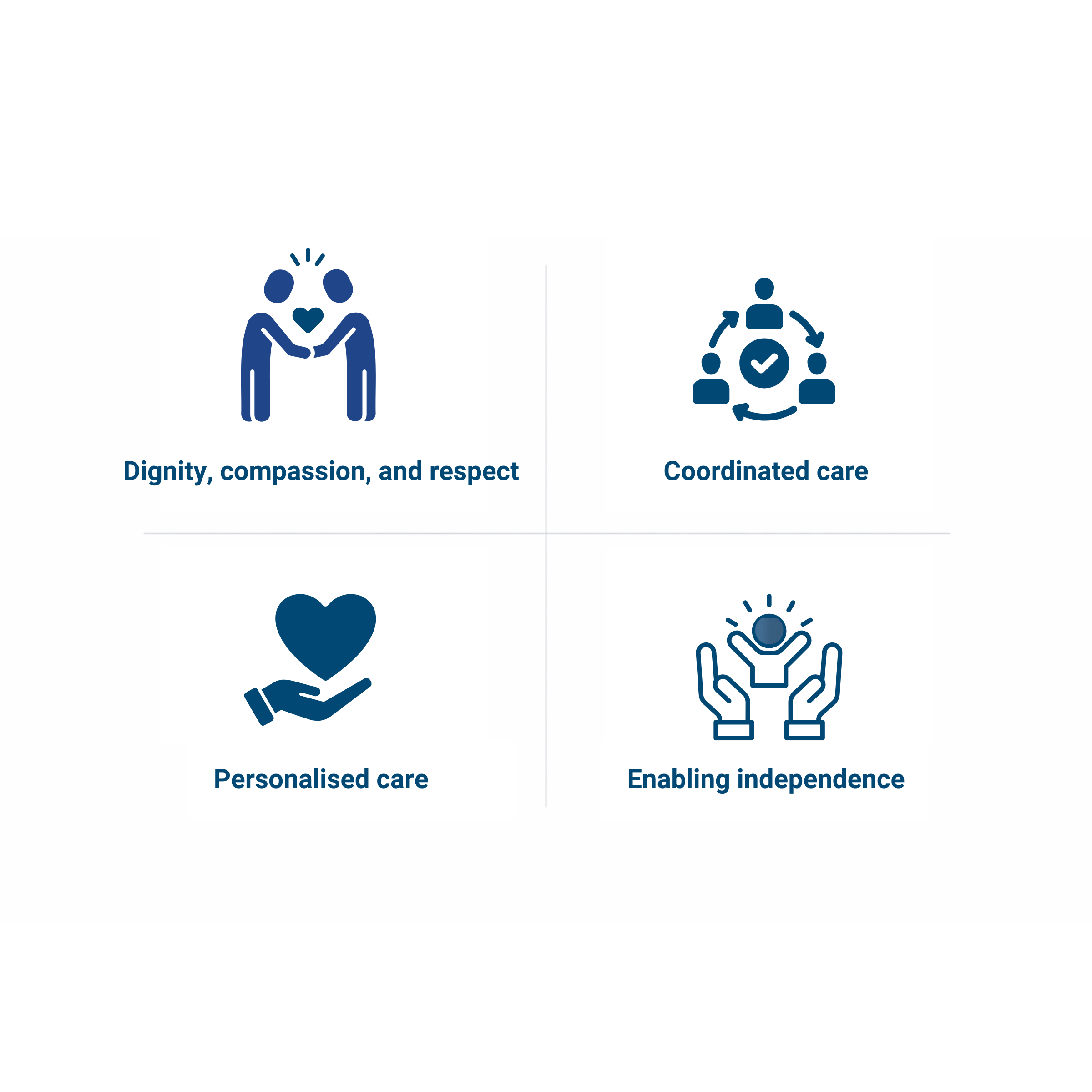
Personalised care requires going beyond the clinical assessment capturing who the person is, their routines, relationships, values, and goals, and ensuring that information actively shapes how care is delivered. Personalisation is not demonstrated by the existence of a care plan. It is demonstrated by whether the care plan influences the interaction.
Enabling independence is the principle most often compromised under time pressure. Rather than completing tasks on behalf of service users, truly person-centred care supports individuals to maintain skills, exercise choice, and retain control over their daily lives. Providers must be able to evidence how their approach promotes independence rather than creating unnecessary dependency.
3. What the CQC Single Assessment Framework Looks For
The CQC Single Assessment Framework evaluates responsiveness by examining whether care is genuinely person-centred. Inspectors will look for evidence that care plans reflect individual preferences, that people are involved in decisions about their care, and that services adapt when needs change. Services that reduce person-centred care to a documentation exercise without evidence of genuine practice are likely to find this reflected in their inspection outcome.
In practical terms, inspectors may seek to establish:
Whether service users and families can describe how their preferences have shaped their care.
Whether staff can articulate an individual’s goals and not just their care tasks.
Whether care plans have been reviewed in response to changing needs, and who was involved.
Whether feedback has resulted in demonstrable changes to care delivery.
Evidence is both documentary and observational. Providers must demonstrate person-centred practice in the records, in the environment, and in conversation.
4. Building the Organisational Conditions for Person-Centred Practice
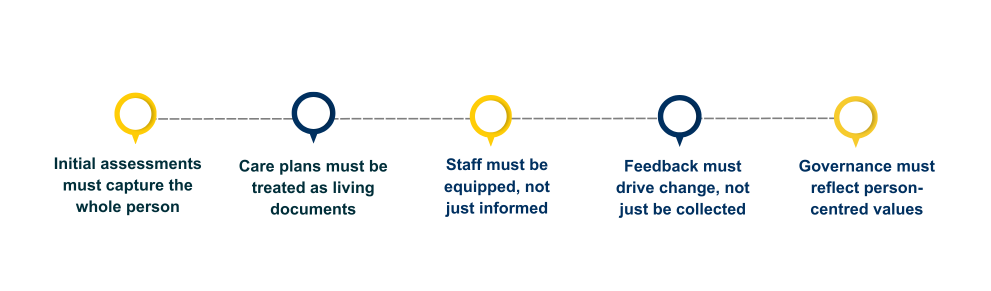
Person-centred care does not emerge from a single policy or training module. It requires the right conditions to exist consistently at every level of service delivery. Providers should focus on the following areas:
Initial assessments must capture the whole person. Beyond clinical need, assessments should explore personal identity, values, cultural and religious considerations, communication preferences, family involvement, and individual goals recorded in a format accessible to all staff delivering care.
Care plans must be treated as living documents. A plan completed at admission and not reviewed until something goes wrong is not a person-centred care plan. Plans must be updated in response to changing needs and following feedback. Review dates must be documented and adhered to.
Staff must be equipped, not just informed. Training must go beyond awareness. Staff need skills to have sensitive conversations, recognise when preferences are not being met, and support individuals with communication difficulties to express their wishes particularly in services supporting people with learning disabilities, autism, dementia, or fluctuating mental capacity.
Feedback must drive change, not just be collected. Providers must demonstrate that service user and family views have a visible impact on care delivery feedback cycles with no documented outcome will not evidence genuine responsiveness.
Governance must reflect person-centred values. Where person-centred practice is treated as secondary to operational efficiency, this will be evident in care records, in staff confidence, and in the experiences described by people using the service.
How Sheridan Consult Can Help

Sheridan Consult supports NHS organisations, local authorities, and independent care providers to close the gap between person-centred policy and person-centred practice. Through expertise in CQC compliance, care planning frameworks, workforce development, and service user engagement, they help providers build the operational conditions for genuinely personalised care delivery.
Tailored support is available across Regulation 9 compliance audits, care planning quality reviews, person-centred practice training, mental capacity assessment frameworks, and co-production processes helping organisations evidence not only what is documented, but what is genuinely delivered.