

The NHS's Medium Term Planning Framework: What "Delivering Change Together" Actually Means for Providers
Date: 20th August, 2026.
Authored by: Doris Sheridan | doris@sheridanconsult.co.uk
In October 2025, NHS England published what it has called the most ambitious plan the health service has produced in a generation: the Medium Term Planning Framework – delivering change together 2026/27 to 2028/29. It sets out how the NHS intends to dramatically reduce waiting times, restore local access to care, and cut bureaucracy all while resetting the foundations to deliver the 10 Year Health Plan.

For providers, commissioners, and anyone working across health and social care, this is far more than a policy document. It's a three-year roadmap that reshapes how services are funded, measured, and delivered and it has direct implications for quality assurance, regulatory alignment, and Continuing Healthcare.
A different way of planning
Until now, NHS planning has largely operated on an annual cycle short-term, centrally directed, and, by NHS England's own admission, one of the biggest barriers to genuine transformation. The Framework marks a deliberate shift away from that model. Backed by a three-year revenue and four-year capital settlement, organisations are now expected to develop robust five-year strategic plans, not just react to the next financial year.
This matters because it changes the rhythm providers need to plan around. Success is intended to be rewarded with greater local freedom; underperformance will be met with proportionate intervention. It's a rules-based system built on the principle that clarity and accountability, not bureaucracy, drive improvement.
The headline delivery commitments
The Framework sets binding targets through to 2028/29, including:
92% of patients waiting under 18 weeks for elective treatment
85% of A&E patients seen within 4 hours, with Category 2 ambulance response improving to an 18-minute average
90% of clinically urgent primary care patients seen same-day
80% of community health activity delivered within 18 weeks
Continued expansion of NHS Talking Therapies and mental health support teams in schools, working toward full national coverage by 2029
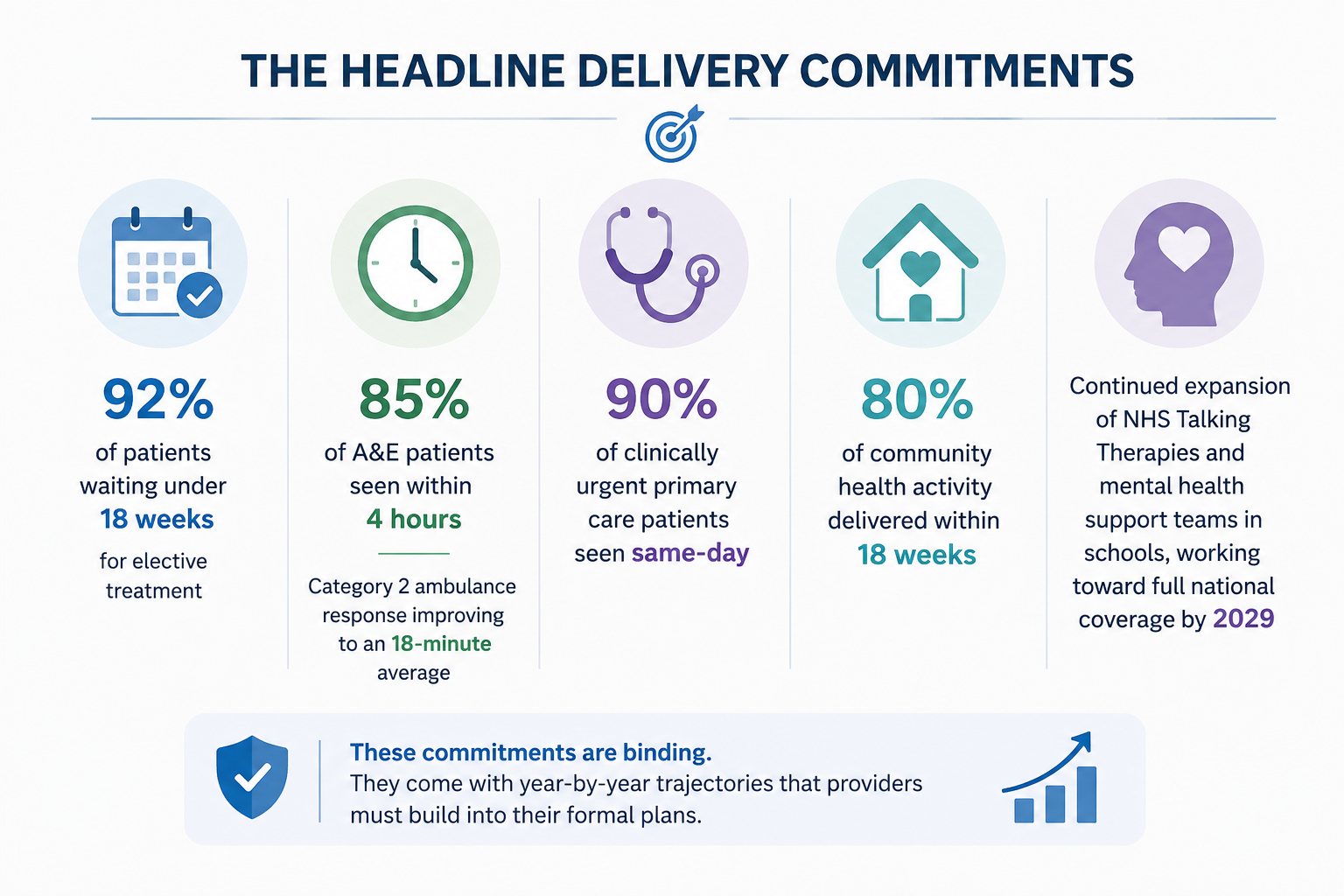
These aren't aspirational statements they come with year-by-year trajectories that providers must build into their formal plans.
Why this matters for quality and Continuing Healthcare specifically
Two elements of the Framework are particularly relevant if you work in compliance, quality assurance, or Continuing Healthcare:
On quality: The Framework confirms that a new National Quality Board Quality Strategy is due by March 2026, alongside new National Care Delivery Standards and a series of "modern service frameworks" beginning with cardiovascular disease, serious mental illness, and sepsis. Crucially, the document explicitly commits to ensuring alignment between the NHS Oversight Framework and the Care Quality Commission on provider capability meaning the direction CQC is already moving in (sector-specific rigour, outcome-focused judgements) is being reinforced, not contradicted, from the NHS planning side.
On Continuing Healthcare: The Framework directly instructs ICBs and providers to continue focusing on the quality and efficiency of all-age continuing care (AACC) services, explicitly naming the reduction of unwarranted variation while meeting statutory NHS Continuing Healthcare obligations. It also confirms that ICBs must prepare for full transition to the AACC Data Set v2.0 by March 2027 a new digital infrastructure replacing the current quarterly data collection. For anyone supporting CHC claims or auditing CHC processes, this is a concrete signal that reporting, monitoring, and variation in CHC decision-making are formally on NHS England's radar over the next three years.
The bigger structural shifts
Underpinning all of this are changes that will reshape how care is organised locally:
Neighbourhood health teams are being established to deliver proactive, community-based support for people with frailty and long-term conditions, working jointly with social care.
Integrated Health Organisations, a new contract-based delivery model, will enable end-to-end redesign of care pathways in areas where integration adds most value.
A digital-first default is being embedded across the NHS App, outpatient care, and urgent care access with clear milestones running through to 2028/29.
Commissioning of vaccination and screening services will move to ICBs, likely from April 2027.
What this means for you
Whether you're a provider preparing five-year strategic plans, a commissioner responsible for AACC oversight, or a family navigating a CHC claim within a system that is actively being restructured, this Framework is the backdrop against which the next three years of decisions will be made. Understanding its priorities and where quality, CHC, and CQC alignment sit within it puts you in a stronger position to anticipate change rather than simply respond to it.
How Sheridan Consult can help

Navigating a planning and regulatory landscape this complex spanning NHS structural reform, CQC's evolving frameworks, and Continuing Healthcare's own data and quality requirements is not something providers or families should have to piece together alone. Sheridan Consult works alongside health and social care providers to interpret exactly what national policy shifts like this mean in practice, and supports families and professionals navigating CHC, quality assurance, and regulatory change with clarity and confidence. If you'd like to discuss how the Medium Term Planning Framework affects your organisation or your care journey, we'd welcome the conversation.