
CHC Eligibility: What to Check Before Your Assessment
Date: 14th August, 2026.
Authored by: Doris Sheridan | doris@sheridanconsult.co.uk
Continuing Healthcare (CHC) funding is one of the most misunderstood areas of care law and one of the highest-stakes decisions a family will navigate. It's fully funded NHS support for people with significant, ongoing health needs, covering both healthcare and the social care that flows from it. There's no means test involved, and it can be worth a substantial amount over time. Yet the eligibility rate at full assessment has fallen sharply over the past decade, down to around 16-17% today, compared to over 30% just a few years ago. That drop doesn't necessarily mean fewer people need this support. More often, it means fewer people are prepared enough, going in, to have their needs properly recognised and evidenced.
Here's what I'd want any family to understand and check before an assessment.
Understand what CHC actually assesses
CHC isn't about diagnosis, age, or which condition someone has. It's about need specifically, whether a person has a "primary health need" that goes beyond what social care can reasonably be expected to provide. Two people with the same diagnosis can have very different outcomes, because eligibility is built around the nature of the need, not the label attached to it.
Assessors score across 12 care domains: breathing, nutrition (food and drink), continence, skin integrity and tissue viability, mobility, communication, psychological and emotional needs, cognition, behaviour, drug therapies and medication, altered states of consciousness, and other significant needs.
Crucially, eligibility rarely hinges on any single domain in isolation. It hinges on the combination of needs, and most importantly on whether those needs are complex, intense, unpredictable, or unstable. Those four words carry real legal weight in CHC decisions, and they are the words too many care notes fail to reflect, even when the reality on the ground clearly meets them.
Keep a record before the assessment, not just during it
The strongest CHC cases aren't built in the assessment room. They're built in the weeks beforehand, through evidence that captures what a single meeting cannot.
Before an assessment, it's worth having ready:
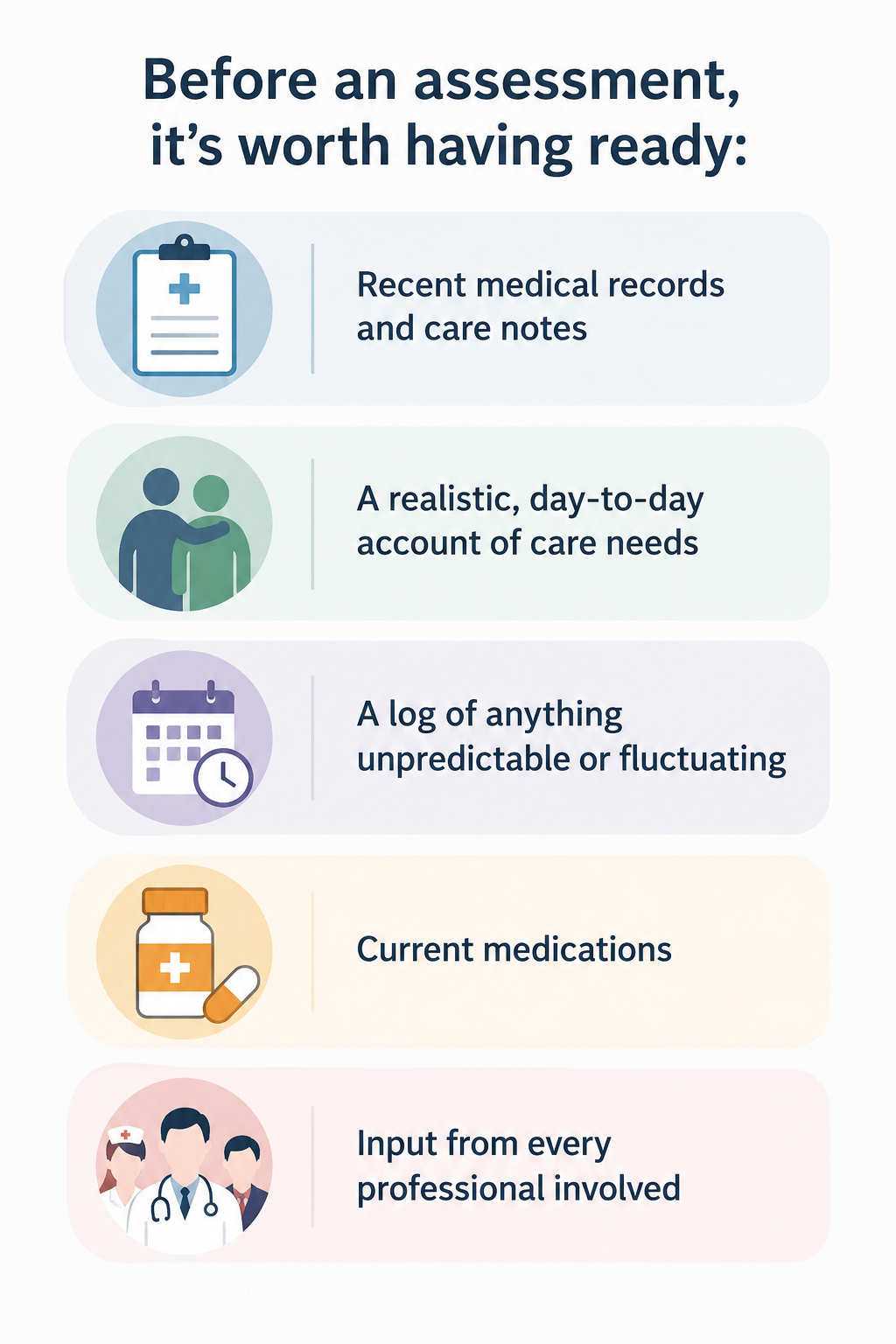
Recent medical records and care notes: GP letters, hospital discharge summaries, district nursing notes, and any recent care plan updates
A realistic, day-to-day account of care needs: not a "good day" description, but a representative picture of how much support is genuinely needed, how often, and by whom
A log of anything unpredictable or fluctuating: falls, hospital admissions, sudden changes in behaviour, missed or extended care visits due to complexity, episodes of distress or confusion
Current medications, including anything recently started, stopped, or increased, and why
Input from every professional involved: not just the GP. District nurses, specialist consultants, physiotherapists, and care staff often hold observations that never make it into the paperwork unless someone specifically asks for them
Unpredictability and fluctuation are two of the strongest indicators of a primary health need in CHC decisions but only when there's documented evidence of them over time. A single snapshot rarely tells that story. A diary kept consistently over several weeks almost always does.
Know the process, and who should be in the room
A CHC pathway usually begins with a Checklist assessment, a short screening tool used to decide whether a full assessment is warranted. If it proceeds, a Decision Support Tool (DST) meeting brings together health and social care professionals sometimes alongside the family to score need across the 12 domains and reach a recommendation, which is then reviewed and ratified by the Integrated Care Board (ICB).
Before that meeting takes place, it's worth checking:
Who is representing the person's interests. A family member, appointed representative, or independent advocate should be present, briefed, and ready to speak to the evidence
Whether every relevant professional has actually been asked to contribute evidence doesn't appear automatically; it often has to be requested
Whether the language in the notes reflects CHC criteria "unstable," "unpredictable," "complex," "intense" rather than generic descriptions that undersell the reality of the need
How much notice you've had, and whether that's enough time to gather everything above. If it isn't, you can ask for the meeting to be rescheduled
Know your rights if you disagree with the outcome
A negative decision is not the end of the road. Families are entitled to:
A written explanation of the decision, including how each domain was scored and why
A formal review, usually through the ICB's local resolution or independent review process
Independent advocacy or professional representation, particularly where the case is complex or the family feels out of their depth navigating it alone

Too many families accept an outcome simply because they don't realise it can be challenged or because they don't know what kind of evidence a successful challenge actually requires. A weak initial assessment can often be strengthened significantly on review, provided the right evidence is brought forward.
The bottom line
CHC eligibility isn't really a question of how unwell someone is. It's a question of whether that need has been properly evidenced, in the right language, against the right criteria before the Checklist, during the DST meeting, and after the decision if it needs to be challenged. Preparation doesn't guarantee a particular outcome. But it gives the person being assessed the fairest possible hearing, and it gives the family the confidence that nothing was missed.
How Sheridan Consult can help

Navigating a CHC assessment while caring for someone you love is exhausting enough without also having to decode NHS terminology and process on your own. At Sheridan Consult, we support families through every stage of the CHC journey helping you gather and organise the right evidence beforehand, attending or preparing you for DST meetings, and reviewing outcomes where a decision doesn't reflect the reality of the care being provided. Where an assessment has already gone the wrong way, we also support formal reviews and appeals, drawing on our experience of what CHC panels are actually looking for. If you're approaching an assessment, or unsure whether a past decision was the right one, we'd welcome the conversation.