

What ISO 9001 Clause 5 Actually Demands from Leadership and Where Most Organisations Fall Short
Date: 23rd June, 2026.
Authored By: James Sheridan | james@sheridanconsult.co.uk
Most organisations treat ISO 9001 certification as proof that quality is under control. Clause 5 exists to test whether that's actually true at the top of the business, not just on the shop floor or in the care delivery team.

Clause 5, "Leadership," is the part of the standard that auditors increasingly use to separate organisations that have built a genuine quality culture from those that have simply built a quality department. The requirement is direct: top management cannot delegate accountability for the Quality Management System (QMS) to a Quality Manager and call it compliance. Leadership has to own it.
This article sets out exactly what Clause 5 requires, and the patterns we see repeatedly when organisations get it wrong.
1. What Clause 5 Actually Requires
Clause 5 is built around three sub-clauses. Each one assigns a specific obligation to top management, not to the quality function.
Leadership and Commitment
Top management must hold ultimate accountability for whether the QMS works, not just whether it exists. This means quality objectives have to align with the organisation's actual strategic direction, resources have to be made available without leadership treating that as someone else's budget line, and customer focus has to be visibly driven from the top down. A QMS that runs independently of business strategy fails this requirement regardless of how well it's documented.
Policy
A Quality Policy is a leadership commitment, not a compliance artefact. It has to be established, communicated, and genuinely understood across the organisation, and it has to function as the framework from which quality objectives are built. A policy nobody can describe in their own words is not meeting this requirement, no matter how professionally it reads.
Organisational Roles, Responsibilities, and Authorities
People need to know, with no ambiguity, who is accountable for QMS performance, who has the authority to stop a non-conforming process, and who escalates issues when something isn't working. Where this isn't clearly assigned and communicated, problems get managed through guesswork rather than authority.
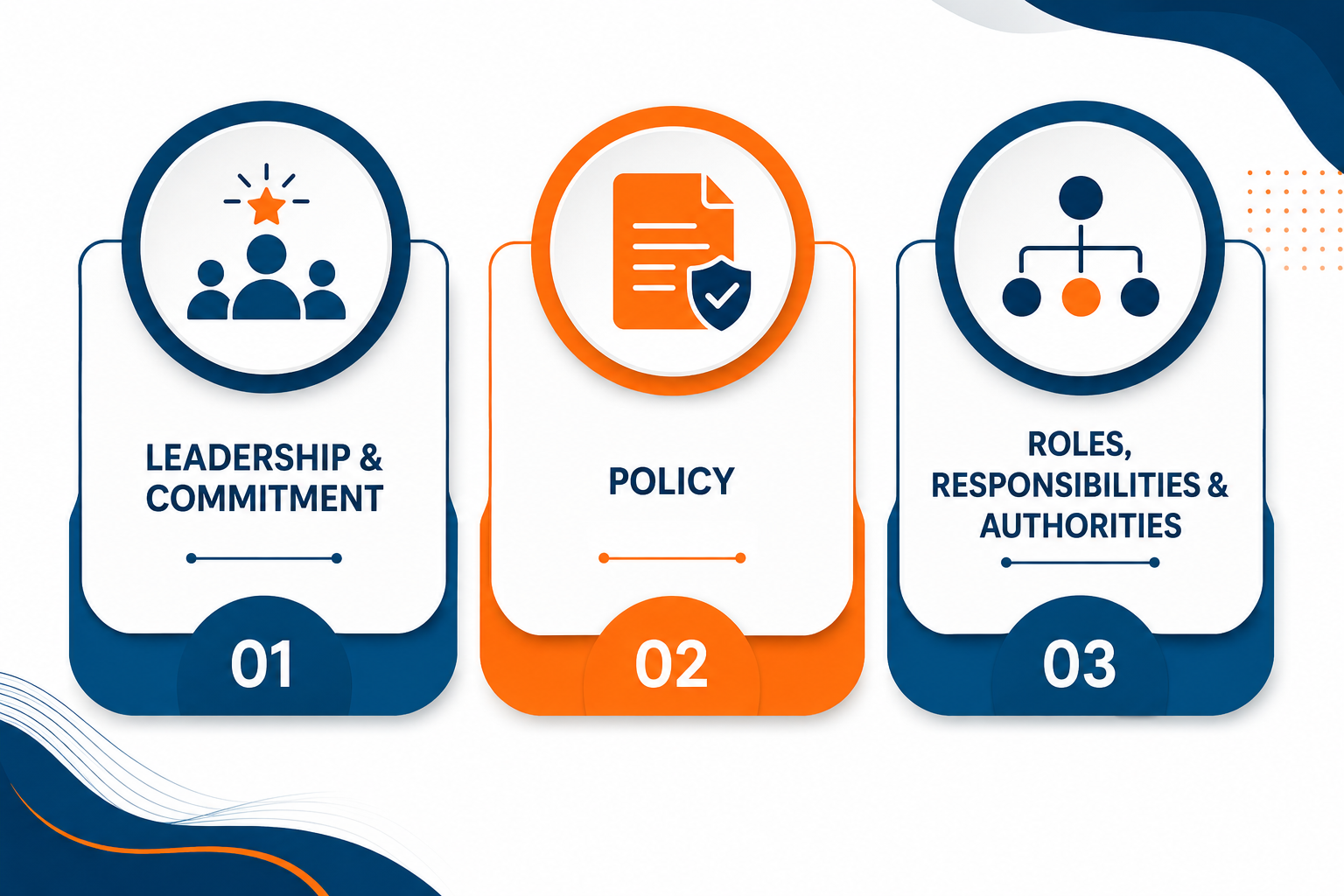
Taken together, these three sub-clauses are asking one question: is quality something leadership actively runs, or something leadership has assigned away?
2. Where Most Organisations Fall Short
Certification bodies see the same failure patterns repeatedly. None of them are about technical non-compliance. They're about leadership behaviour.
Delegating Quality to "The Quality Person"
This is the most common failure we see. Executives treat ISO 9001 as the Quality Manager's responsibility to manage and their job to sign off. Clause 5.1 explicitly requires top management to be engaged in QMS planning and performance, not simply briefed on it after the fact. If leadership only hears about quality issues in a summary report, the standard isn't being met.
Management Reviews Without Management
Clause 9.3 requires management reviews, but Clause 5 is what determines whether those reviews mean anything. Too often, top management is absent, disengaged, or treating the review as a status update rather than a strategic decision point. A management review that doesn't change anything isn't a review. It's a meeting.
Quality Policies That Say Nothing
A policy copied from a template, signed once, and never referenced again does not satisfy Clause 5.2. If a policy could apply to any organisation in any sector, it isn't reflecting this organisation's actual strategic direction, and staff will recognise that immediately even if an auditor doesn't ask the right question to expose it.
Authority Without Clarity
When roles are defined loosely, people default to avoiding blame rather than fixing the underlying process. Clause 5.3 exists specifically to prevent this. If staff aren't sure who can halt a non-conforming process, the organisation has a structural problem, not a training problem.
Quality Running Parallel to the Business
The QMS should not be a separate system that operations tolerates alongside "the real work." Clause 5 requires quality to be integrated into how the business actually operates day to day. Where it sits apart from operational decision-making, it will always be the first thing cut under pressure and that is precisely the failure mode the clause is designed to catch.

3. What This Looks Like in Practice
Genuine Clause 5 compliance is visible in specific, observable behaviours:
Top management can describe the organisation's quality objectives without reading from a slide.
Management reviews produce decisions and actions, not just minutes.
Staff at every level can name who holds authority over their process and what happens when something goes wrong.
The Quality Policy reflects what the organisation is actually trying to achieve, not generic language borrowed from a template.
Resourcing decisions show that quality was considered, not bypassed, when budgets were set.
Where any of these is missing, certification may still hold but the leadership requirement behind it is not being met, and it will surface eventually, either at audit or in performance.
4. Building Leadership Engagement That Holds Up
Closing the gap between certified and genuinely led requires deliberate structural choices, not more documentation.
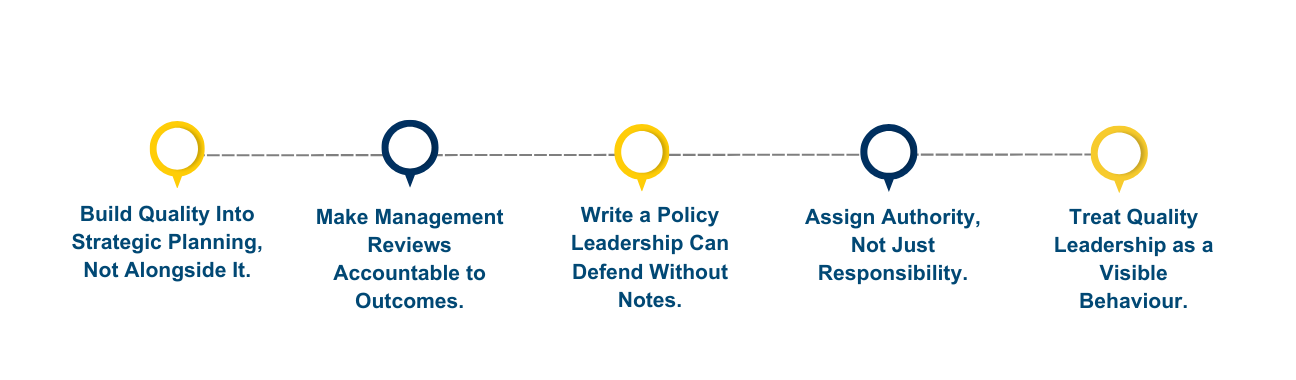
Build Quality Into Strategic Planning, Not Alongside It
Quality objectives should be set in the same conversations as commercial and operational targets, not derived from them afterwards.
Make Management Reviews Accountable to Outcomes
Every review should produce decisions with owners and deadlines. A review with no actions attached has not functioned as Clause 5 intends.
Write a Policy Leadership Can Defend Without Notes
If senior leaders can't explain the Quality Policy in their own words, it isn't doing its job.
Assign Authority, Not Just Responsibility
Staff need to know who can act, not just who is "responsible" on paper. Authority that isn't backed by clear escalation routes will not be used.
Treat Quality Leadership as a Visible Behaviour
Staff read leadership commitment through what gets prioritised under pressure, not what's written in the manual.
How Sheridan Consult Can Help
Sheridan Consult works with organisations across health, social care, and professional services to close the gap between ISO 9001 certification and genuine leadership engagement with quality. Through QMS audits, management review design, quality policy development, and leadership accountability frameworks, we help organisations move Clause 5 from a paper requirement to an operating reality one that holds up under audit and delivers results that matter to the business.
If this is relevant to your organisation, we are happy to have a conversation.