
What Does Rights Based Care Actually Look Like?
Date: 29th June, 2026.
Authored By: Doris Sheridan | doris@sheridanconsult.co.uk
Compliance tells you what is required. Culture determines what actually happens.
Every health and social care organisation in England operates within a clear regulatory framework the Care Act 2014, the Mental Capacity Act 2005, the Human Rights Act 1998, and CQC's assessment standards all set out what good care looks like on paper. But meeting those requirements on paper and living them in practice are two different things. The organisations that get this right are not the ones with the most detailed policies. They are the ones where dignity, autonomy, and person-centred decision-making are embedded in the small, everyday choices staff make not reserved for the moments when someone is watching.
This article explores what a genuinely rights-based culture looks like in practice, and how organisations can build it day to day, one consistent choice at a time.
What a Rights-Based Culture Actually Means
A rights-based culture is not a document. It is not a training session completed once a year. It is the accumulated effect of thousands of small decisions made by staff, every day, that either respect a person's dignity and autonomy or quietly erode it.
It shows up in how a care worker knocks before entering a room, even when the door is already open. It shows up in whether someone is asked what they would like to wear, rather than simply being dressed in whatever is convenient. It shows up in whether a person's "unwise" decision is respected as their right to make, rather than quietly overridden because it feels safer to intervene.
None of these moments appear in an audit. All of them determine whether a person experiences care that respects who they are, or care that simply manages them.
Building It Day to Day, Not Through a Single Policy Update
The temptation in any organisation is to treat culture change as a project a new policy, a training day, a poster in the staff room. These things matter, but they are not where culture actually changes. Culture changes through repetition, modelling, and consistency at the level of daily practice.
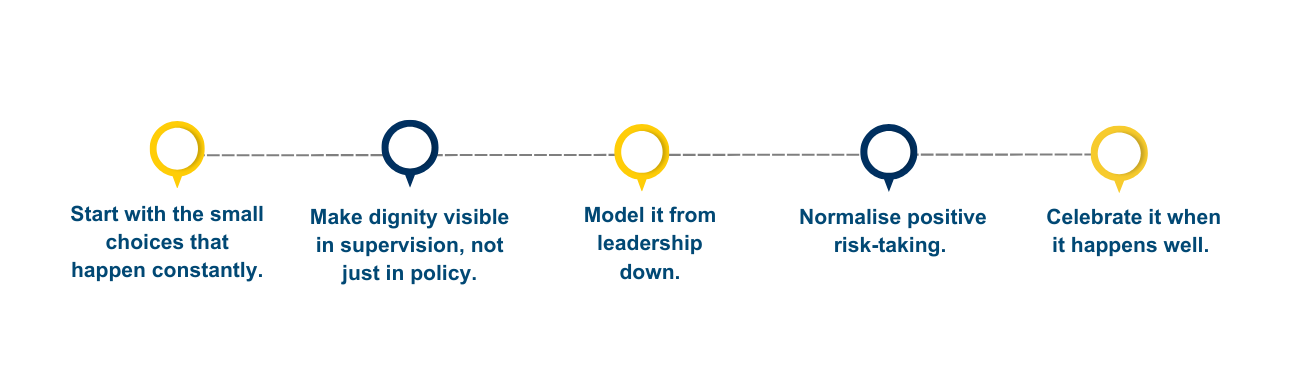
Start with the small choices that happen constantly. Every shift involves dozens of small moments where a person's autonomy can be respected or overlooked what time they eat, who they spend time with, how a decision about their day is made. Building a rights-based culture means paying attention to these moments specifically, not just the big, formal decisions.
Make dignity visible in supervision, not just in policy. Reflective supervision sessions are one of the most underused tools for embedding rights-based practice. When staff are asked regularly not just during incident reviews "tell me about a moment this week where you supported someone's choice," it signals that this is something the organisation genuinely values, not just requires.
Model it from leadership down. Staff absorb culture from what leaders do, not just what leaders say. A registered manager who consistently asks "what would this person want?" before making a decision on their behalf sets a standard that filters through the entire team. Culture is taught far more through example than through instruction.
Normalise positive risk-taking. A rights-based culture recognises that respecting autonomy sometimes means supporting a person to take a risk that feels uncomfortable. Organisations that build genuine confidence around positive risk-taking with clear documentation and proportionate judgement create space for real choice, rather than defaulting to the safest, most restrictive option every time.
Celebrate it when it happens well. Cultures that recognise and share examples of good rights-based practice a story in a team meeting, a mention in a newsletter, a moment acknowledged by a manager reinforce the behaviour far more effectively than any policy reminder.
Why This Matters Now
Recent legal developments around deprivation of liberty have placed a sharper spotlight on how organisations evidence genuine engagement with a person's rights, not just procedural compliance. This is a meaningful opportunity. Organisations that have already built a rights-based culture into their daily practice will find that evidencing it is straightforward because it is simply how they already work. Organisations that have treated rights as a compliance exercise will find the gap between policy and practice much harder to close quickly.
The shift is not about doing more paperwork. It is about ensuring that the genuine, lived experience of the people in your care reflects the values your organisation says it holds.
What Good Looks Like
A rights-based culture is visible in small, observable ways. Staff who can describe, without hesitation, how they supported someone's choice this week. Care plans that read as though they were written with the person, not about them. Teams where positive risk-taking is discussed openly rather than avoided defensively. Leaders who ask about a person's wishes before asking about the risk register.
None of this requires a complete overhaul. It requires consistency, attention, and a genuine belief that the small choices matter as much as the big ones.
How Sheridan Consult Can Help
At Sheridan Consult, we work with health and social care organisations to embed rights-based practice into everyday culture not just policy documents. Our work includes reviewing how autonomy and dignity are reflected in care planning and daily practice, supporting reflective supervision models that genuinely reinforce person-centred values, and helping leadership teams model and embed the standards they want to see across their organisation.

If this is relevant to your organisation, we are happy to have a conversation.