
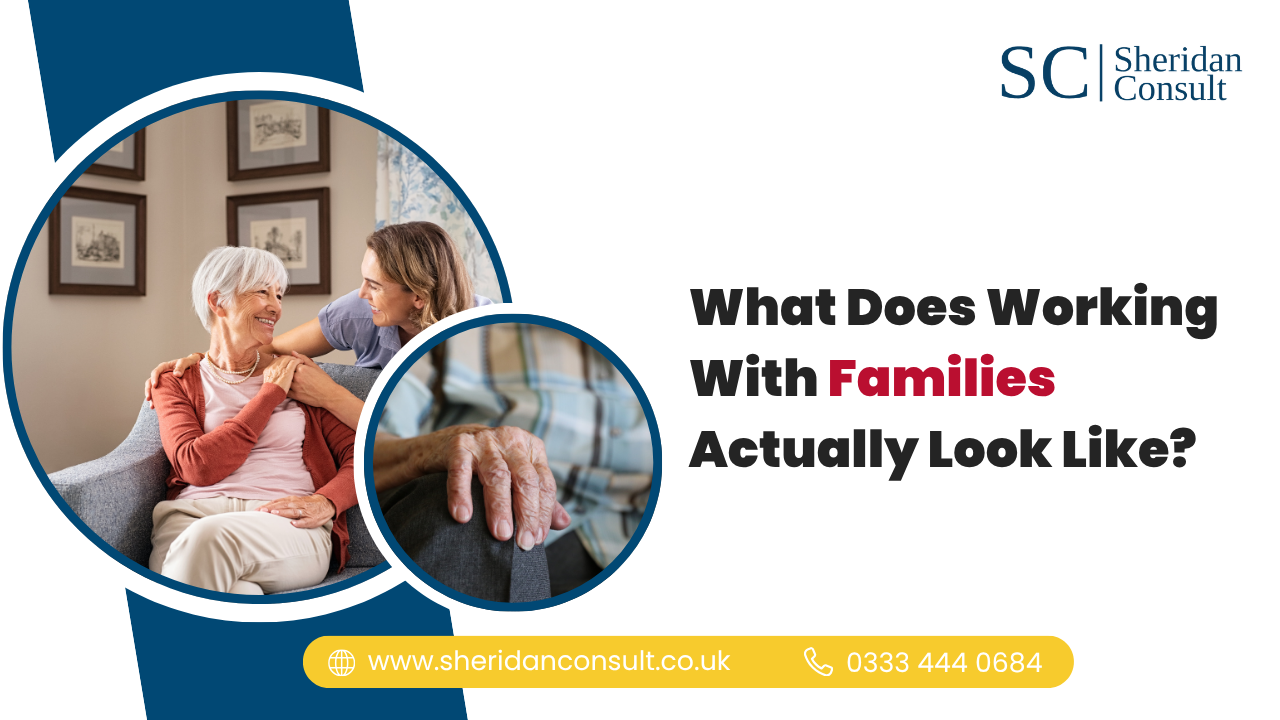
What Does Working With Families Actually Look Like?
Date: 10th September, 2026.
Authored by: Doris Sheridan | doris@sheridanconsult.co.uk
Policy tells staff who to contact. Practice determines whose voice actually shapes the decision.
Every adult social care provider in England works within a clear framework for family and carer involvement. The Care Act 2014, the Mental Capacity Act 2005, the Human Rights Act 1998 and CQC's assessment standards all point in the same direction: families, friends and unpaid carers can be essential partners in a person's life, and their involvement should be welcomed. But welcoming that involvement and knowing where its limits sit are two different skills. The organisations that get this right are not the ones with the most detailed "next of kin" policy. They are the ones where staff instinctively know, in an ordinary Tuesday afternoon conversation, whose voice is being heard and whose voice is deciding. This article looks at what that actually looks like in daily practice, and how organisations build it deliberately rather than leaving it to chance.
What Working With Families Actually Means
Working with families is not a box ticked on an admission form. It is not "next of kin" recorded once and never revisited. It is the accumulated effect of small, daily decisions about who is told what, who is asked first, and whose account of a situation is treated as the accurate one.
It shows up in whether a relative is told "let me check with them first" rather than simply being given the answer. It shows up in whether a person is asked who they want involved in their care, rather than family involvement being assumed by default because someone turned up to the assessment. It shows up in whether a disagreement between what a person wants and what a relative is worried about gets recorded as two distinct positions, rather than quietly merged into one version that happens to favour whoever spoke first or loudest.
None of these moments appear on a family involvement policy. All of them determine whether a person experiences family support that strengthens their voice, or family involvement that gradually replaces it.

Building It Day to Day, Not Through a Single Family Policy
Start the conversation at first contact, not when there is a problem. At assessment, admission, or the start of a service, staff should have a clear conversation with the person about who matters to them and how they want those people involved. Waiting until a dispute arises to work this out means the organisation is defining the relationship reactively, under pressure, rather than on the person's own terms.
Record who is involved, and who deliberately is not. A useful record covers preferred contacts and emergency contacts, but it should equally capture the people a person does not want involved, what information can be shared with whom, and by which method. This is often the gap that surfaces first when something goes wrong.
Keep the person's account separate from everyone else's. When views differ, the record should distinguish clearly between what the person says they want, what a relative's concern is, what the professional assessment concludes, and what was actually decided. Blending these into a single narrative is how a person's wishes quietly get overwritten by a relative's anxiety, without anyone deciding that should happen.
Treat consent as something reviewed, not assumed. Families reasonably want reassurance and updates, particularly where they provide significant support. But a person has a right to privacy, and being someone's next of kin is not, on its own, a right to their confidential information. Staff should check what has actually been agreed, share only what falls within that agreement, and revisit consent as circumstances, capacity or relationships change.
Treat capacity as decision-specific, every time. A diagnosis, a disability, or a disagreement with relatives does not mean a person lacks capacity, and neither does an unwise decision. Capacity is specific to the particular decision and the moment it needs to be made. Good practice means defining the exact decision, giving the person practical support to make it, assessing capacity only where there is a genuine reason to doubt it, and recording their views, past wishes and values regardless of the outcome. Where capacity is genuinely lacking, relatives contribute views and knowledge as partners, not as decision-makers, unless they hold the legal authority to be one.
Why This Matters Now
Recent legal developments in deprivation of liberty law have placed a sharper focus on wishes, feelings and objection when determining whether someone's arrangements are lawful. That shift raises the profile of exactly the records described above: who was consulted, what the person's own view was, and how family involvement was distinguished from professional judgement. Organisations that already keep these threads separate in daily practice will find this straightforward to evidence, because it is simply how they already record things. Organisations that have treated family involvement as an administrative field on a form will find the gap between what they hold on file and what they need to show much harder to close under scrutiny.
What Good Looks Like
A strong culture around family involvement is visible in specific, observable ways. Staff who can explain, without hesitation, who is involved in a person's care and why, and who deliberately is not. Care plans that record the person's own words alongside, not instead of, a relative's concerns. Consent decisions that are documented, dated and revisited as things change. Capacity assessments that are tied to one specific decision at one specific point in time, not a general label applied to a person across every choice they make.

None of this requires a system overhaul. It requires a consistent habit of asking, at every point of contact: whose voice is this, and have we checked?
How Sheridan Consult Can Help
At Sheridan Consult, we support NHS organisations, Local Authorities and health and social care providers to strengthen how family involvement, consent and capacity are recorded and practised, not just documented. Our work includes reviewing how family involvement and consent are reflected in care planning and daily practice, supporting supervision models that reinforce person-centred decision-making, and helping leadership teams build consistent practice around capacity and best interests across their teams.
If this is relevant to your organisation, we are happy to have a conversation.