

When Should You Go to the Court of Protection? A Guide for Providers and Councils
Date: 27th November, 2026.
Authored by: Doris Sheridan | doris@sheridanconsult.co.uk
Most decisions for people who lack capacity never need a court. The Court of Protection is for the ones that cannot be resolved any other way.
Teams often know a case is difficult long before they know whether it belongs in court. The question usually arrives under pressure: a family disagrees with a clinical view, a restriction in supported living has grown, or nobody holds the legal authority to decide. This guide sets out the situations that may need the Court of Protection, who can apply, and what to expect once you do.
Start by asking whether you need a court at all
The Court of Protection was set up by the Mental Capacity Act 2005. It can make a decision, or appoint someone to make one, for a person who lacks capacity where the matter cannot be resolved in another way.
That means the Act's own process comes first. Assess capacity for the specific decision. If the person lacks capacity, make a best interests decision, consult the people who matter to them and involve an IMCA where one is needed. Guidance issued by the Vice President of the Court of Protection in 2020 says that where decision makers follow the Act, professional guidance and the Code of Practice, and agree on capacity and best interests, treatment may proceed without an application, and section 5 of the Act provides protection. Calling a treatment "serious" does not by itself require a court. It calls for extra care in the process.
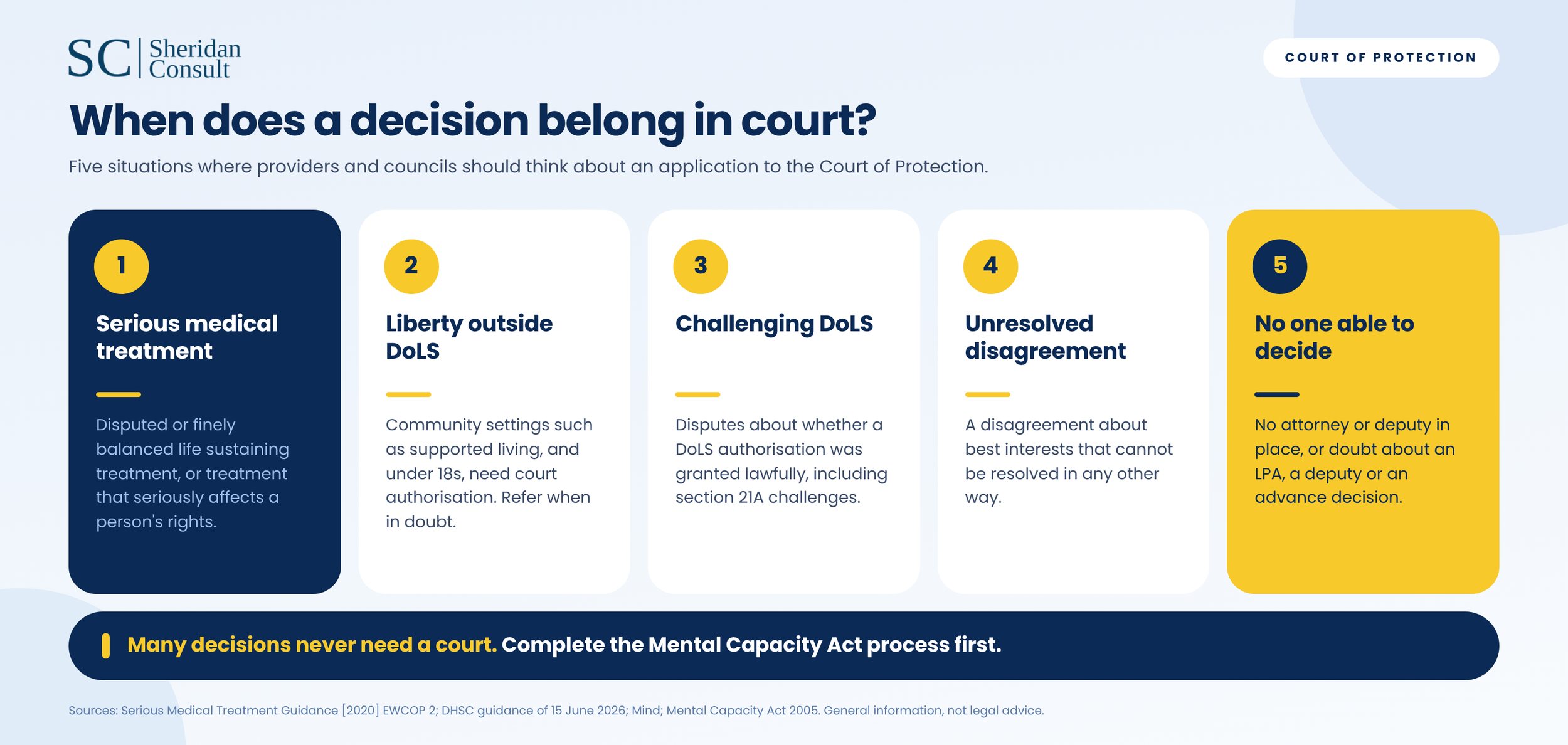
Five situations that may need the court
1. Serious medical treatment. The 2020 guidance says an application must be made for life sustaining treatment where concerns remain at the end of the decision making process. Examples are a finely balanced decision, a difference of medical opinion, disagreement among the people interested in the person's welfare, or a possible conflict of interest. The same applies to withholding or withdrawing clinically assisted nutrition and hydration, and to restraint that goes beyond sections 5 and 6 of the Act and so amounts to a deprivation of liberty. An application is highly probable where treatment seriously interferes with a person's rights, such as sterilisation, donation of an organ or tissue for another person, covert insertion of contraception, or experimental treatment.
In March 2026 the Court of Appeal went further in Townsend v Epsom and St Helier, holding that unresolved disagreement after the clinical process should go to the Court of Protection. The Supreme Court has listed an appeal against that decision for 12 to 13 January 2027, so watch for the outcome.
2. Deprivation of liberty outside the DoLS. The Deprivation of Liberty Safeguards apply to people aged 18 and over in care homes and hospitals. In community settings such as supported living, deprivation of liberty needs authorisation through the Court of Protection. For children, authorisation comes through the Court of Protection or the High Court's inherent jurisdiction. Since the Supreme Court's judgment of 2 June 2026 changed the test, DHSC guidance says to refer or apply to the court where there is doubt, where the person's views fluctuate, where restrictions are significant, or where Article 5 of the European Convention on Human Rights may be engaged.
3. Challenging a DoLS authorisation. The court can decide whether a DoLS authorisation was granted lawfully and can settle disputes about how the safeguards are used. A relevant person's representative can bring a section 21A challenge without needing permission.
4. A disagreement that cannot be resolved. Where those involved cannot agree what is in the person's best interests, and an IMCA, mediation or a second opinion has not resolved it, the court can decide.
5. Nobody able to decide, or doubt about the paperwork. The court can decide health or care matters where there is no attorney or deputy, appoint a deputy (usually for property and finances, as welfare deputies are rare), rule on whether a lasting power of attorney or advance decision is valid or what it means, and remove an attorney or deputy.
Who can apply, and what it costs
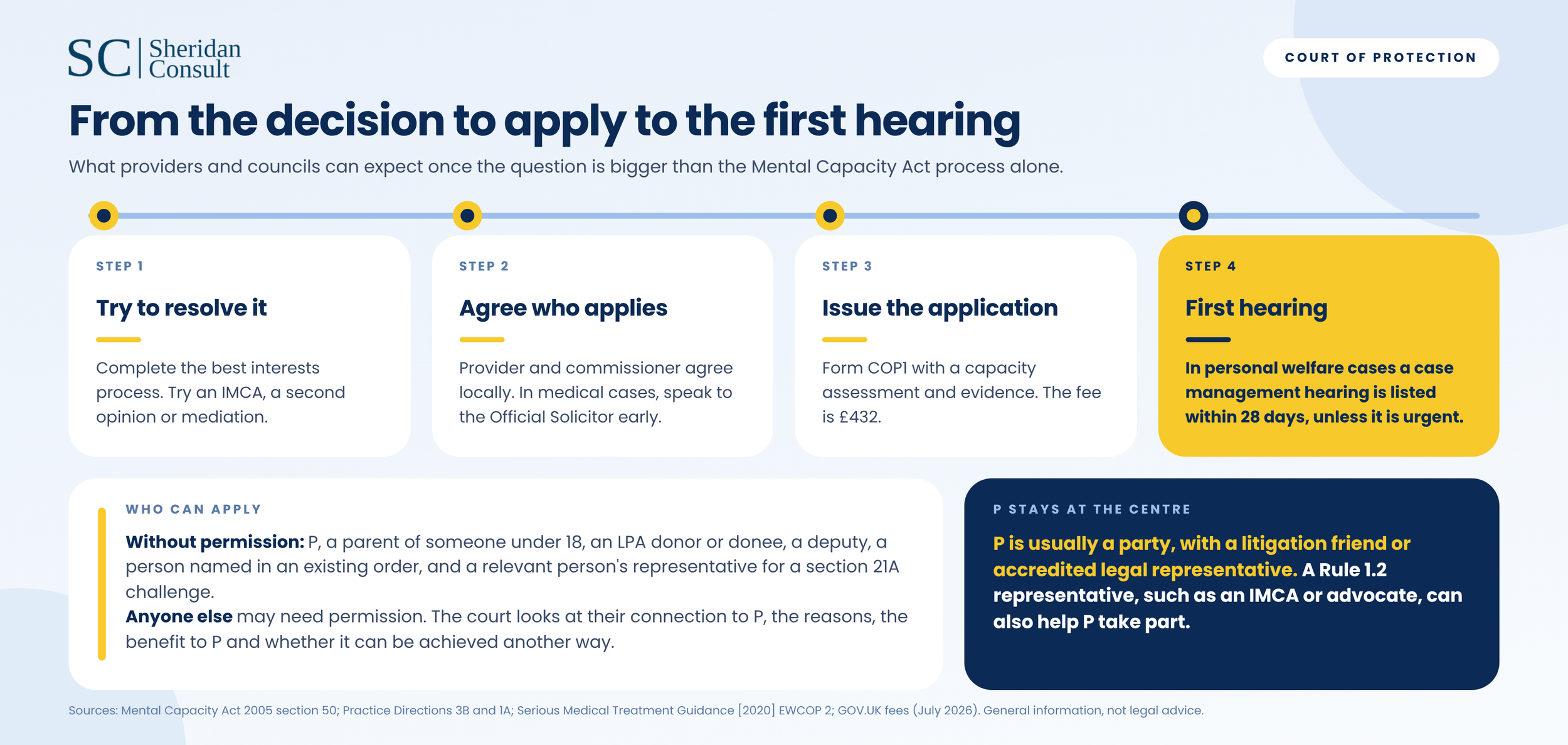
Under section 50 of the Mental Capacity Act, these people can apply without permission: the person who lacks or is alleged to lack capacity, anyone with parental responsibility for a person under 18, the donor or donee of a lasting power of attorney, a court appointed deputy, a person named in an existing order where the application relates to it, and a relevant person's representative for a section 21A application. Anyone else needs permission, subject to the Court of Protection Rules. When deciding, the court considers the applicant's connection with the person, the reasons for the application, the benefit to the person of the order sought, and whether that benefit can be achieved another way. Check the current Rules with your legal team for how this applies to your organisation.
In practice, the 2020 guidance expects providers and commissioners of clinical and care services to bring applications that are needed, and the responsible organisation will normally be the applicant. Local agreement about who applies is essential.
The application fee is £432 for both personal welfare and property applications. A hearing fee of £266 is payable where the court has held a hearing and made a final order, declaration or decision. Help with fees may be available. The fees page was last updated on 21 July 2026, so check it on the day.
What to expect once you apply
The person stays at the centre. The court must consider in every case how P will take part. P may speak to the judge directly or indirectly, and is usually joined as a party. If P lacks capacity to conduct the proceedings, a litigation friend or, in suitable cases, an accredited legal representative acts for them. In serious medical treatment cases the Official Solicitor usually acts as litigation friend, and the caring organisation normally meets half of the costs. The court can also appoint a Rule 1.2 representative, who could be an IMCA, a Care Act advocate, a family member or anyone with relevant knowledge.
What goes in. In personal welfare cases, before issuing you should identify all the likely respondents and interested parties, notify them and P where possible, explain what you plan to do and try to resolve matters. The application should include a draft order, the reasons, a needs and risk assessment, a support plan, evidence of consultation, best interests meeting minutes and a capacity report. A section 21A application does not need the capacity report.
Timing. In personal welfare cases a judge reviews the case and lists a case management conference within 28 days of issue, unless the case is urgent. Serious medical treatment cases normally go to a Tier 3 judge. If a case is urgent, you must explain why, what the consequences of not treating it as urgent would be, and which issues are urgent. The 2020 guidance notes that the Official Solicitor has no out of hours service, so plan early rather than relying on last minute applications.
Outcome. The court may make a declaration about lawfulness under section 15 of the Act, a decision under section 16, or both.
Before you apply: a five point checklist
Check the process is complete and recorded. Capacity assessed for the specific decision, best interests considered, the right people consulted.
Name the trigger. Which of the five situations applies, and why does this case fall into it?
Try to resolve it, and record what you tried. An IMCA, a second opinion, a best interests meeting or mediation.
Agree who applies and who pays. Settle it between provider, commissioner and council early, and in medical cases speak to the Official Solicitor.
Prepare the evidence and P's voice. Gather the documents the court will expect and show how P's wishes and feelings were found out.
Do not let the search for the perfect application cause delay. The 2020 guidance says delay is generally harmful to the person, so issue promptly if matters cannot be resolved within their timescales.
How Sheridan Consult can help
Sheridan Consult supports health and social care organisations with Court of Protection, Mental Capacity and complex case work, including DoLS, Streamlined Re X, best interests decision making, and IMCA and Rule 1.2 support. If your team is deciding whether a case needs to go to court, we offer a free consultation.
Call 0333 444 0684, email office@sheridanconsult.co.uk, or visit https://www.sheridanconsult.co.uk/contact-us. We are available Monday to Friday, 10am to 6pm.
This article is general information, not legal advice.