

What Happens When a Deprivation of Liberty Is Identified in a Domestic Setting?
Date: 20th July, 2026.
Authored By: Doris Sheridan | doris@sheridanconsult.co.uk
When most people think about deprivation of liberty in health and social care, they think about care homes and hospitals. They think about locked doors, restricted movement, and the formal DoLS authorisation process that governs those settings. What is far less understood and far less discussed is what happens when a deprivation of liberty is identified not in a registered care setting, but in someone's own home, or in the home of a family member or private carer.

This is not a rare situation. As more people are supported in community and domestic settings through direct payments, personal budgets, and informal family care arrangements the likelihood of deprivation of liberty arising outside of registered settings is increasing. And yet the legal framework that governs it, and the professional responsibilities that follow from it, remain among the least understood areas of Mental Capacity Act practice.
This article explains what a deprivation of liberty in a domestic setting looks like, what the law requires when one is identified, and what organisations and professionals must do to ensure the person at the centre of it is properly protected.
What Changed After Cheshire West
For over a decade, the Supreme Court's 2014 ruling in Cheshire West set the standard for identifying a deprivation of liberty: the "acid test," asking simply whether a person was under continuous supervision and control and not free to leave. Crucially, that ruling also confirmed that the setting was irrelevant a deprivation of liberty could occur anywhere, including in a person's own home.
That position no longer stands. In a judgment handed down on 2 June 2026, the Supreme Court overruled its own 2014 decision, declaring that the acid test was wrong in principle and had never actually been the standard used by the European Court of Human Rights. The Court found the bright-line test too crude, leading to an over-extensive interpretation of deprivation of liberty. In its place, the Court restored a multifactorial approach, requiring consideration of the individual's specific circumstances, including the type, duration, effects and context of the restrictions and giving new weight to whether the person has given valid consent.
For professionals working in domestic settings, this changes the threshold question. A person's lack of capacity under the Mental Capacity Act no longer automatically means they cannot give valid consent to their living arrangements someone who is conscious of their environment, has a basic understanding, and can express that they're content with the situation may be found to have validly consented, which takes the situation outside Article 5 altogether. This does not remove the need for careful assessment if anything, it demands more nuanced judgment, not less. Where a genuine deprivation of liberty is still identified in a domestic setting, the route to lawful authorisation remains unchanged: an application to the Court of Protection under Section 16 of the Mental Capacity Act 2005, since DoLS still applies only to care homes and hospitals.

What a Domestic Deprivation of Liberty Looks Like in Practice
Identifying a deprivation of liberty in a domestic setting is not always straightforward. The arrangements in question may have developed gradually, may be managed by a devoted family member with the best of intentions, and may look on the surface like ordinary family life.
Common scenarios include an adult with a learning disability living with a parent or family carer who manages all aspects of their daily life, including who they see, where they go, and what they do. Or an older adult with dementia living at home with a spouse or adult child who has put in place arrangements, including locked doors, alarms, or constant supervision to keep them safe.
In both situations, the restriction may be entirely well-intentioned and practically necessary. But necessity and good intentions do not determine legality. Whether these arrangements require authorisation now depends on a fuller picture than capacity alone, including whether the person has given valid consent to their living arrangements, and the type, duration, effects, and context of the restrictions in place. Where that assessment finds a genuine deprivation of liberty, the legal framework requires that it be authorised, regardless of the relationship between the person and the carer, and regardless of how caring and appropriate the arrangements appear.
The Professional Responsibility to Identify and Act
For social workers, community nurses, and other professionals visiting people in domestic settings, the responsibility to identify potential deprivations of liberty is clear. Where a professional identifies arrangements that may amount to a deprivation of liberty — and where an assessment finds the person has not given valid consent to those arrangements they have a professional and legal obligation to act.
This does not mean removing the person from their home or disrupting care arrangements that are working well for them. It means ensuring that those arrangements are brought within a lawful framework, which, in a domestic setting, means making an application to the Court of Protection.
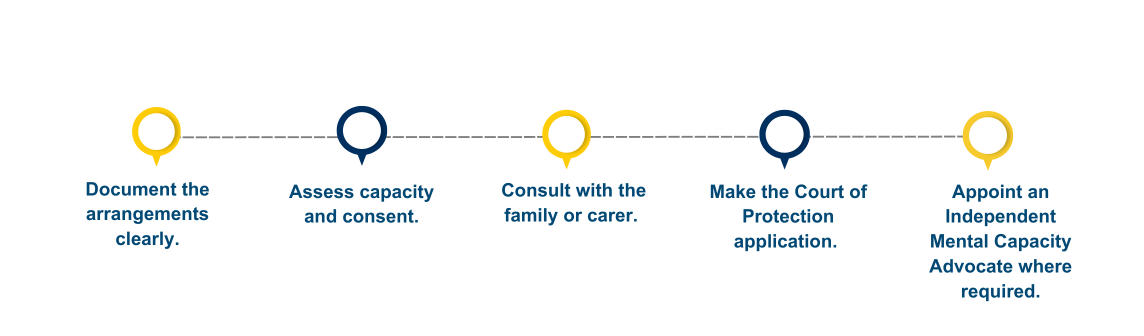
The professional steps that follow identification are straightforward in principle, though they require careful handling in practice.
Document the arrangements clearly. Before any application is made, the nature of the arrangements and the restrictions in place need to be documented clearly and honestly. What supervision is in place, how consistently it is applied, whether the person attempts to leave or resist, and what happens when they do all of this, form the basis of the application.
Assess capacity and consent. A formal, decision-specific capacity assessment must still be completed. But capacity alone no longer settles the question; the assessment must also consider whether the person has given valid consent to the arrangements, based on their expressed wishes and feelings, as well as the type, duration, effects, and context of the restrictions. This fuller assessment must be documented thoroughly and conducted in line with the principles of the Mental Capacity Act.
Consult with the family or carer. Where the deprivation of liberty has been put in place by a family member or private carer, that person needs to be involved in the process sensitively and transparently. In many cases, family carers are unaware that the arrangements they have put in place require legal authorisation. The professional role here is to explain the legal position clearly, without blame, and to support the family through the Court of Protection process.
Make the Court of Protection application. An application under Section 16 of the Mental Capacity Act must be made to the Court of Protection to authorise the deprivation of liberty. The application should set out the nature of the arrangements, the person's circumstances and care needs, the outcome of the capacity assessment, and why the arrangements are in the person's best interests. Where the situation is urgent, an urgent or without-notice application can be made.
Appoint an Independent Mental Capacity Advocate where required. Where the person has no appropriate person to support them through the process, or where there is a conflict of interest, an IMCA must be appointed. This is a statutory requirement and not a matter of professional discretion.
The Role of the Local Authority
Local authorities have a significant role to play in domestic deprivation of liberty situations, both in identifying them and in supporting the Court of Protection process. Under the Care Act 2014, local authorities have a duty to promote the wellbeing of people in their area and to ensure that care and support arrangements are lawful and rights-respecting.
Where a local authority becomes aware of a potential deprivation of liberty in a domestic setting through a safeguarding referral, a care review, or a professional visit, it has a responsibility to assess the situation, support the family or carer, and, where necessary, initiate or support the Court of Protection application process.
This is an area where specialist knowledge makes a material difference. Court of Protection applications require careful preparation, clear documentation, and a thorough understanding of the legal framework. Local authorities that do not have this expertise in-house should seek specialist support rather than allow situations to drift without legal authorisation.
What This Matters
An unauthorised deprivation of liberty in a domestic setting is not a technical breach of process. It is an ongoing violation of a person's fundamental rights under Article 5 of the European Convention on Human Rights, the right to liberty and security. The fact that it is happening in a loving home, managed by a devoted family member, does not change its legal status.
For professionals, the obligation is clear. Identifying a potential deprivation of liberty in a domestic setting and failing to act is not a neutral position. It is a failure to protect a person whose rights the law has specifically provided for.

For families and carers, the message is equally important. The Court of Protection process is not a threat to the care arrangements you have put in place. It is the legal mechanism that makes those arrangements lawful, protects you as a carer, and ensures that the person you are supporting has the independent oversight and safeguards they are entitled to.
How Sheridan Consult Can Help
At Sheridan Consult, we support local authorities, NHS organisations, social workers, and families navigating deprivation of liberty in domestic settings. Our specialist expertise covers capacity assessments, best interests decision-making, Court of Protection applications, and the identification and management of complex community-based deprivation of liberty situations.
We work alongside professionals and families to ensure that the people at the centre of these situations are properly protected with the legal framework in place to safeguard their rights, support their carers, and provide the independent oversight the law requires.
If your organisation is managing a situation involving potential deprivation of liberty in a domestic or community setting, we would be happy to have a conversation.